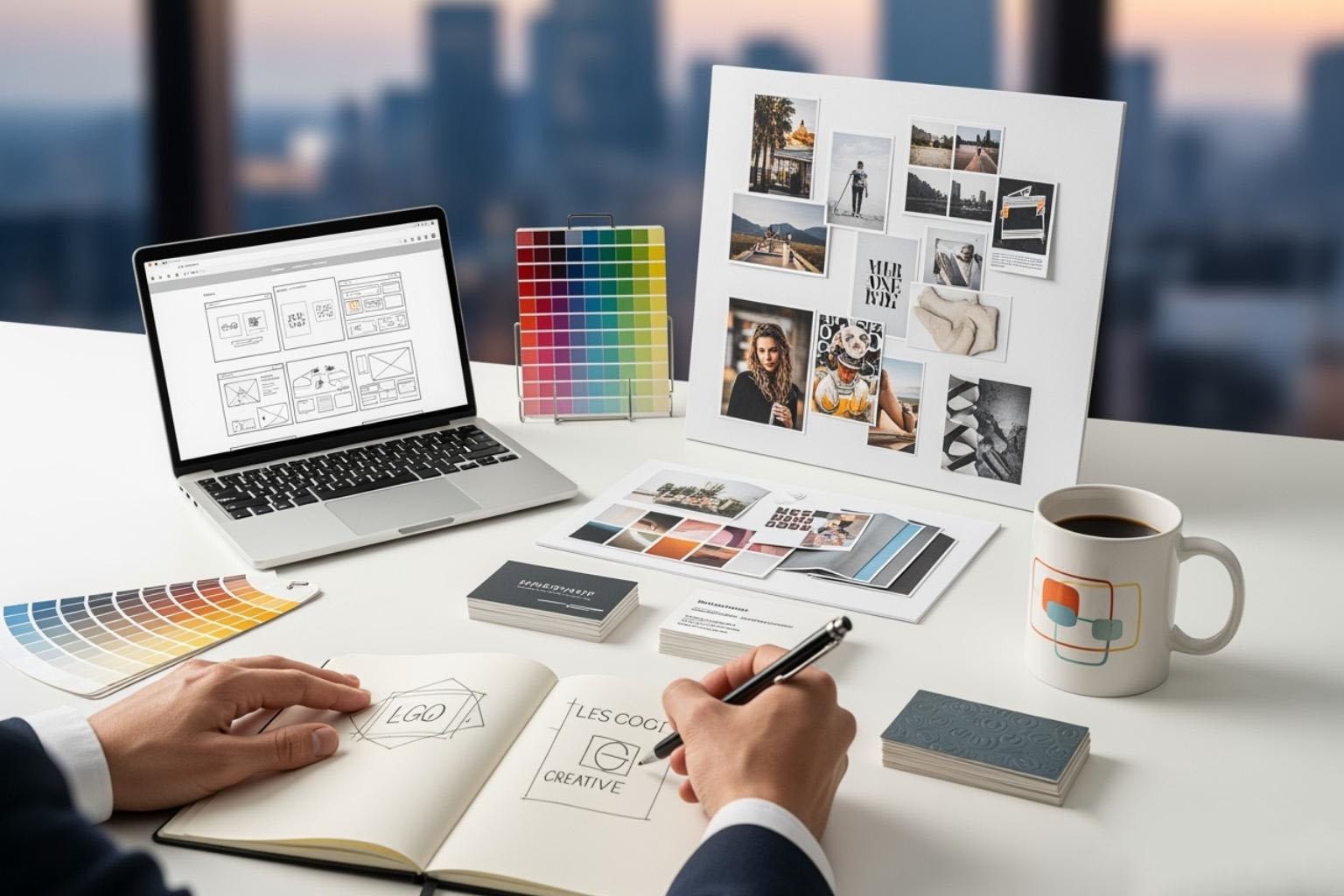

Launching a startup is exciting, but building a recognisable brand takes more than designing a logo. Your logo might be the first thing customers notice, but your brand identity shapes how they recognise, remember, and trust your business.
For founders exploring startup branding Manchester understanding the difference between a logo and a complete brand identity can help you make smarter decisions, avoid unnecessary expenses, and create a consistent customer experience.
Whether you need branding for new businesses Manchester or a complete identity system for a growing company, this seven-step playbook will help you decide what your startup needs now—and what can wait until later.
Logo vs Brand Identity: What Is the Difference?

A logo is a visual symbol that helps people identify your business. It could be a wordmark, icon, or combination of both.
Brand identity is the complete collection of visual and verbal elements that communicate your business’s personality. It includes your logo, colour palette, typography, imagery, tone of voice, messaging, and brand guidelines.
Think of your brand as a house. Your logo is the front door: it creates the first impression. Your brand identity is the entire house, including its structure, rooms, colours, and atmosphere. Every element works together to create a consistent experience.
For startups considering small business branding Manchester, the goal is not to create the biggest brand possible. It is to build the right foundation for your current stage and future growth.
The 7-Step Playbook: Build the Right Brand for Your Startup
Step 1: Define Your Startup’s Brand Foundation
Before designing anything, clarify what your business stands for. Identify your mission, values, target audience, and the problem you solve.
Ask yourself:
- Who are your ideal customers?
- What problem does your startup solve?
- Why should customers choose you over competitors?
- What three words should describe your brand?
For example, a Manchester-based sustainable clothing startup might want to communicate creativity, responsibility, and quality. These attributes should influence every branding decision.
A professional startup branding Manchester strategy starts with positioning, not just visual design.
Do this week: Write a one-paragraph brand statement explaining who you serve, what you offer, and why your business is different.
Step 2: Decide Whether You Need a Logo or a Full Identity
Your current business stage should determine how much branding you need.
| Startup stage | Recommended investment |
|---|---|
| Idea validation | Simple, professional logo and basic colours |
| Pre-launch | Logo, colour palette, typography, and social templates |
| Early customer acquisition | Consistent brand identity and website visuals |
| Growth and expansion | Complete identity system, guidelines, and brand refinement |
If you are testing an idea with a limited budget, a professional logo and a few basic visual rules may be enough to get started.
However, if you are launching a website, advertising campaigns, and social media profiles together, a more complete identity can make your business look consistent from day one.
The right startup branding packages Manchester providers should offer options that match your stage, budget, and business goals rather than forcing every startup into the same package.
Do this week: List the assets you need for launch and separate essential items from features you can add later.
Step 3: Research Your Manchester Competitors
Your brand needs to stand out in a competitive market. Research local businesses serving the same audience and examine how they present themselves.
Look at:
- Competitor logos and colour palettes.
- Website layouts and messaging.
- Social media content and advertising.
- Customer reviews and common complaints.
- Gaps in the market that your startup can address.
Imagine a new Manchester-based accounting startup competing with established firms. Instead of copying traditional corporate branding, it might use approachable messaging, clean visuals, and simple explanations to appeal to freelancers and small businesses.
Effective branding for new businesses Manchester should communicate credibility while giving customers a clear reason to choose you.
Do this week: Review five competitors and identify three opportunities to differentiate your brand.
Step 4: Build a Logo That Works Everywhere
Your logo should be recognisable, readable, and adaptable. It needs to work on your website, social media profiles, business cards, presentations, and mobile screens.
A practical logo system may include:
- A primary logo.
- A simplified icon or symbol.
- A black-and-white version.
- Horizontal and stacked variations.
- Suitable file formats for digital and print use.
Avoid unnecessary details that become difficult to recognise at small sizes. Your logo should support your brand positioning rather than trying to communicate every feature of your business at once.
When comparing the best startup branding agency in Manchester options, review each agency’s portfolio, design process, deliverables, and ability to create versatile logo systems.
Do this week: Test your logo at small and large sizes, in black and white, and on both light and dark backgrounds.
Step 5: Create a Consistent Brand Identity
Once your logo is ready, develop the supporting elements that make your business recognisable across different touchpoints.
Your brand identity should include:
- Colours: A defined palette with primary and supporting colours.
- Typography: Fonts for headings, body copy, and digital interfaces.
- Imagery: A consistent approach to photography, illustrations, or graphics.
- Tone of voice: Guidelines for how your business communicates.
- Brand guidelines: Simple rules explaining how to use these elements consistently.
For a Manchester technology startup, a clean visual system, accessible typography, and clear messaging could help make a complex product feel more approachable.
A well-planned small business branding Manchester project helps ensure that your website, social posts, sales presentations, and marketing materials feel like they belong to the same business.
Do this week: Create a one-page brand sheet with your logo, colour codes, fonts, and three tone-of-voice rules.
Step 6: Apply Your Brand to Real Customer Touchpoints
Branding becomes valuable when customers experience it consistently. A beautiful logo alone cannot compensate for a confusing website or inconsistent messaging.
Start with the places where potential customers are most likely to encounter your business:
- Website homepage and landing pages.
- Social media profiles.
- Email signatures and sales presentations.
- Product packaging or service documents.
- Advertising campaigns and lead-generation forms.
For example, a Manchester startup offering project management software could use the same colours, typography, messaging, and visual style across its website, product screens, LinkedIn page, and sales deck.
If you are comparing startup branding packages Manchester, check whether the deliverables include practical digital assets and guidance for applying your identity—not just a logo file.
Do this week: Update your three most important customer touchpoints so they use the same visual style and core message.
Step 7: Measure Results and Improve Your Brand
Branding is not a one-time design task. As your startup grows, you should evaluate whether your identity is helping customers understand and remember your business.
Track relevant indicators such as:
- Website enquiries and conversion rates.
- Brand-related search impressions.
- Engagement with branded social content.
- Customer feedback and brand recognition.
- Consistency across marketing materials.
If customers repeatedly misunderstand your offer, your messaging may need improvement. If your logo looks inconsistent across platforms, you may need clearer guidelines rather than a complete redesign.
Founders looking for the best startup branding agency in Manchester should prioritise a partner who connects creative decisions to business objectives and helps the brand evolve as the company grows.
Do this week: Establish a simple baseline for website enquiries, conversion rate, and customer feedback. Review the results monthly before deciding what to change.
Manchester Startup Example: From Logo to Complete Brand Identity
Imagine a fictional Manchester startup called NorthLoop, a sustainable packaging company targeting independent retailers and growing ecommerce businesses.
At launch, NorthLoop invests in a simple wordmark and uses it across its website and social media. The logo looks professional, but its marketing materials use inconsistent colours, different fonts, and unclear messaging.
As the business starts attracting customers, the founders realise that a logo alone does not communicate why NorthLoop is different.
They expand their branding with:
- A distinctive colour palette inspired by sustainability and modern manufacturing.
- Consistent typography and product imagery.
- A clear message focused on practical, lower-impact packaging.
- Website and social media templates.
- A short brand guide for future marketing campaigns.
This gives NorthLoop a more consistent identity without requiring an unnecessarily complicated rebrand.
For a business like NorthLoop, branding for new businesses Manchester means creating a recognisable foundation that can grow with the company. The same principles apply to startups in technology, professional services, retail, hospitality, and ecommerce.
The lesson is simple: invest in a logo when you need recognition, and invest in a complete brand identity when you need consistency across multiple customer touchpoints.
How Much Branding Does Your Startup Actually Need?
Your budget should reflect the complexity of your business, the number of customer touchpoints, and your immediate growth goals.
| Requirement | Basic logo project | Complete brand identity |
|---|---|---|
| Logo design | Included | Included |
| Colour palette | Basic | Defined system |
| Typography | Basic recommendation | Full hierarchy |
| Brand messaging | Usually limited | Positioning and voice |
| Social media templates | Optional | Often included |
| Brand guidelines | Basic or limited | More comprehensive |
| Website and marketing application | Usually separate | May be included |
When researching startup branding packages Manchester, request a clear breakdown of deliverables, revisions, file formats, usage rights, and any additional costs.
There is no universal price that suits every startup. A lean identity can be appropriate for a business validating an idea, while a company preparing for a major launch may benefit from a more comprehensive package.
Choose the scope that supports your business goals today while leaving room to expand later.
How to Choose the Right Branding Partner in Manchester
Before hiring an agency, ask these questions:
- Have you worked with startups or businesses in my industry?
- Can I see relevant case studies and completed projects?
- What is included in your branding process?
- Will I receive editable files and brand guidelines?
- Can the identity scale as my company grows?
- How will you help me apply the brand across digital channels?
The best startup branding agency in Manchester for your business is not necessarily the largest or most expensive. It is the one that understands your audience, communicates its process clearly, and delivers an identity that fits your goals and budget.
If you are exploring small business branding Manchester, focus on strategic thinking, useful deliverables, clear communication, and the ability to maintain consistency as your business develops.
Ready to Build Your Startup Brand?
Your logo is an important starting point, but your brand identity is what brings your business together across every customer interaction.
Start with a clear strategy, choose a logo that works everywhere, build a consistent visual system, and apply it to your most important marketing channels. You can expand your identity as your startup grows.
If you are launching a new venture or refining an existing brand, explore our startup branding Manchester services to find an approach that fits your stage and business objectives.
Internal link: Explore our Startup Branding in Manchester page
Discover branding solutions designed to help Manchester startups build recognition, communicate value, and create a consistent presence from launch to growth.
Frequently Asked Questions
1. Is a logo enough for a new startup?
A logo can be enough during early idea validation. Once you begin marketing across several channels, a consistent brand identity helps customers recognise and understand your business.
2. What is included in startup branding?
Depending on the project, startup branding may include brand strategy, logo design, colour palettes, typography, messaging, social media templates, and brand guidelines.
3. When should a startup invest in a complete brand identity?
Consider a complete identity when preparing for launch, building a website, attracting investors, running campaigns, or expanding into new markets.
4. How do I choose startup branding packages in Manchester?
Compare the scope of work, portfolio, strategic approach, revisions, file formats, usage rights, and support available after delivery. Choose a package that meets your actual business needs.
5. Why does startup branding matter for small businesses?
Consistent branding can help small businesses look professional, communicate their value, build recognition, and create a more coherent customer experience.
6. Should I hire a branding agency or design my own logo?
You can start independently if your budget is limited and your needs are simple. A branding agency may be valuable when you need strategic positioning, a complete identity system, or consistent assets across multiple channels.