
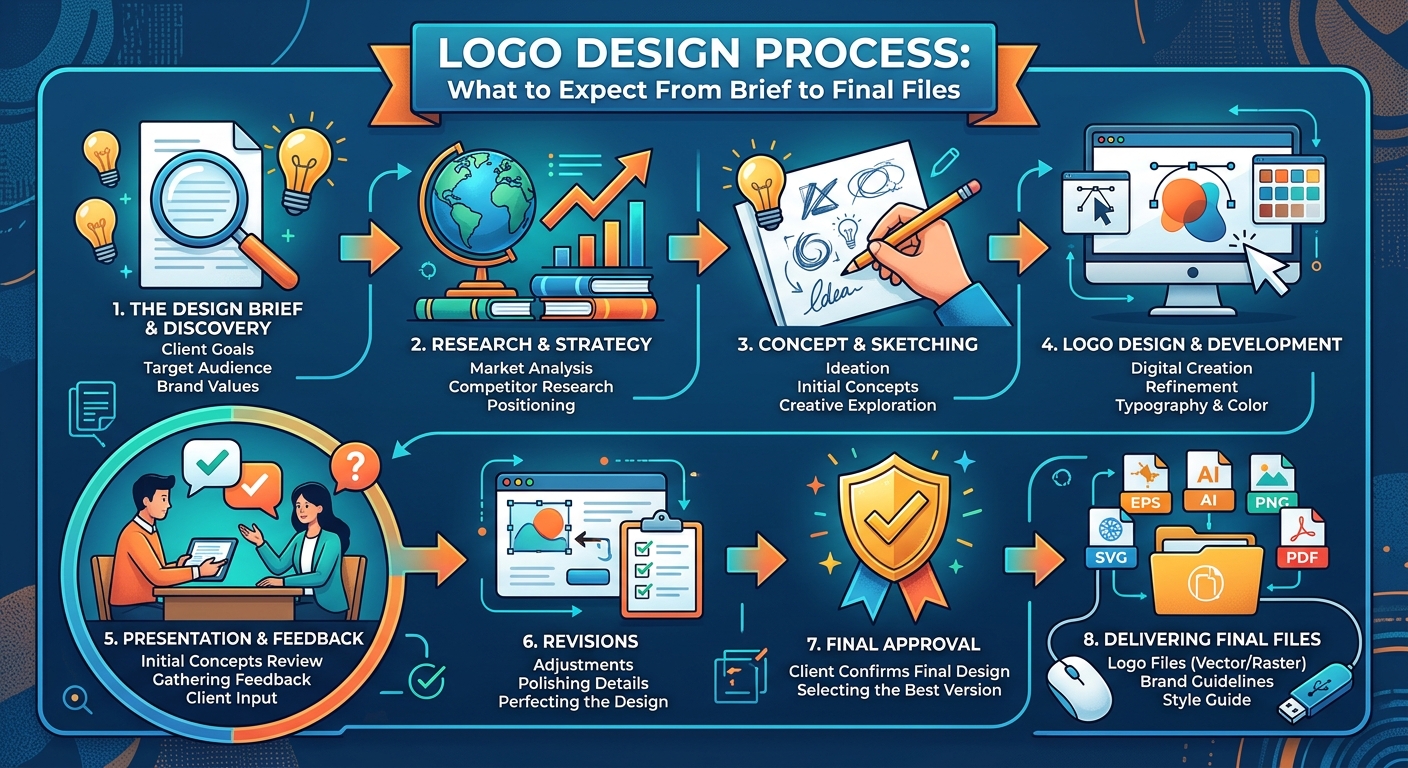
Whether you are launching a startup, refreshing an established business, or investing in professional logo design services, knowing what happens from the initial brief to the final files makes the experience easier and more productive.
At Brands Design, our approach follows five core stages: Discover, Define, Design, Deliver, and Grow. Here is a step-by-step guide to what you can expect, how long each stage takes, and what we need from you.
What Is the Logo Design Process?
The logo design process is a structured workflow that transforms your business goals and ideas into a distinctive, usable logo. It typically includes research, strategy, creative exploration, feedback, refinement, and delivery of final files.
A professional logo design process ensures that the final result is not only visually appealing but also appropriate for your target audience, industry, and long-term business goals.
7 Logo Design Process Steps: From Brief to Final Files
1. Discover: Understand Your Business and Audience
The first step is learning about your business, your customers, your competitors, and your goals. This discovery stage provides the foundation for meaningful design decisions.

Your designer may ask about:
- Your business name and industry
- Your products or services
- Your target audience
- Your brand personality and values
- Your main competitors
- Your preferred design styles and colours
- Where you plan to use your logo
This research helps identify opportunities to create a logo that stands apart from competing brands.
2. Define: Build a Clear Logo Design Brief
Once the research is complete, the next step is to define the creative direction. A clear logo design brief keeps the project focused and helps everyone understand what success looks like.
The brief may include your brand positioning, audience preferences, visual references, colour direction, typography preferences, and practical requirements.
For example, a technology startup may need a modern, minimal logo, while a heritage brand may benefit from a more traditional visual identity.
A well-defined brief reduces misunderstandings and makes the professional logo design process more efficient.
3. Design: Explore Logo Concepts
With the strategy established, the designer begins exploring creative concepts. This stage may involve typography experiments, icon development, shapes, colour combinations, and different logo compositions.
Depending on the project scope, you may receive a selection of initial concepts to review.
The goal is not simply to create something attractive. Each concept should reflect your brand strategy and work across the platforms where customers encounter your business.
4. Review: Share Feedback and Refine the Design
After reviewing the concepts, you provide feedback on the strongest direction. Your designer then refines the selected concept according to the agreed project scope.
Useful feedback is specific and connected to your business objectives. Instead of saying, “I do not like it,” explain whether the design feels too formal, lacks visibility at small sizes, or does not appeal to your target audience.
This collaborative stage helps improve the logo while keeping the project aligned with its original goals.
5. Deliver: Prepare Your Final Logo Files
Once the design is approved, your designer prepares the final logo files for practical use.
Depending on your package, deliverables may include:
- SVG files for scalable digital use
- EPS or other vector files for professional printing
- PNG files with transparent backgrounds
- JPG files for everyday digital use
- Full-colour, black, white, and monochrome variations
- Horizontal and stacked logo layouts, where applicable
- Basic logo usage guidance, if included in your package
Always confirm which formats and variations are included in your professional logo design services before the project begins.
6. Grow: Apply Your Logo Across Your Brand
Your logo is the starting point of your visual identity, not the entire brand. Once it is approved, it needs to be applied consistently across your website, social media, packaging, business cards, marketing materials, and other customer touchpoints.
As your business grows, you may also need supporting brand assets, typography guidelines, a colour palette, or a broader brand identity system.
A consistent approach helps customers recognise your business and builds a more professional brand experience.
7. Protect: Maintain Brand Consistency
The final step is making sure your logo remains clear and consistent wherever it appears.
Keep your approved files organised, use the correct logo variations, and avoid stretching, distorting, or changing the colours of your logo without a clear reason.
For growing businesses, a simple brand guide can help employees, marketers, developers, and print suppliers use the logo correctly.
How Long Does the Logo Design Process Take?
A typical logo design project may take 2–3 weeks, depending on the brief, project complexity, feedback speed, and number of revision rounds.
| Stage | Estimated timeline |
|---|---|
| Discover and research | 2–3 days |
| Define the creative brief | 1–2 days |
| Develop initial concepts | 4–6 days |
| Review and refine | 3–5 days |
| Prepare final files | 1–2 days |
| Typical total | Approximately 2–3 weeks |
These are indicative estimates, not guaranteed deadlines. Some stages may overlap, and projects requiring extensive research, additional concepts, or multiple revision rounds can take longer.
Providing clear feedback promptly can help keep the project on schedule.
What We Need From You: Logo Design Checklist
Before starting your project, prepare the following information to help your designer understand your expectations.
- Your business name and tagline, if applicable
- A short description of your business
- Your target audience and main markets
- Your brand values and personality
- Examples of logos or visual styles you like
- Competitor websites or brands for reference
- Preferred colours and any colours to avoid
- Where you plan to use your logo
- Your budget and expected deadline
- One main contact person for feedback and approval
You do not need to have every detail finalised. A good designer can guide you through the questions and help clarify your creative direction.
Common Logo Design Mistakes to Avoid
Understanding what to expect from the logo design process can help you avoid problems that lead to wasted time or additional costs.
Starting without a clear brief: Unclear goals can result in concepts that do not fit your business.
Following trends blindly: A logo should support your brand identity rather than rely entirely on temporary design trends.
Ignoring practical applications: A design that looks good on a large screen may become difficult to read on a small icon or printed label.
Providing vague feedback: Specific, objective feedback makes revisions more productive.
Forgetting final file formats: Make sure you receive the file types required for your website, social media, printing, and other applications.
Expecting unlimited revisions: Confirm the number of included revision rounds and the process for requesting additional work before the project starts.
Why Choose Professional Logo Design Services?
Professional logo design services combine creative thinking with research, strategy, and technical preparation. Rather than choosing a design based on appearance alone, you receive a considered approach to representing your business.
A professional designer can help you:
- Develop a logo aligned with your business goals
- Create a distinctive visual direction
- Improve readability across different sizes and platforms
- Prepare appropriate digital and print files
- Establish a foundation for a consistent brand identity
The right process also makes communication, approvals, and delivery more predictable.
Frequently Asked Questions
What are the main steps in the logo design process?
The main stages are discovery, defining the creative direction, concept development, feedback and refinement, final file delivery, brand implementation, and ongoing consistency.
How long does professional logo design take?
A typical logo design project takes around 2–3 weeks. The actual timeline depends on the complexity of the brief, project scope, revisions, and approval speed.
What should I prepare before hiring a logo designer?
Prepare your business details, target audience, brand goals, visual references, preferred colours, intended logo applications, budget, and deadline.
What files should I receive with my final logo?
Common deliverables include SVG, PNG, JPG, and vector files suitable for printing, depending on the agreed package. Confirm the exact formats and variations with your designer.
How many logo concepts and revisions should I expect?
This depends on the service package. Ask your designer how many concepts and revision rounds are included, what counts as a revision, and whether additional changes incur extra costs.
Is a logo enough to establish a brand identity?
A logo is an important starting point, but a complete brand identity may also include typography, colours, imagery, graphic elements, and usage guidelines.
Start Your Logo Design Project With Confidence
A clear logo design process makes it easier to turn your business vision into a professional visual identity. From discovery and strategy to creative development, refinement, and final file delivery, each stage plays an important role in creating a logo that works for your brand.
If you are ready to build a distinctive identity for your business, explore our professional logo design services at Brands Design and take the next step towards a stronger brand.
Ready to get started? Contact Brands Design to discuss your project, goals, and logo design requirements.
