
Logo vs Brand Identity: The Ultimate Guide for Startups
Starting a business comes with many decisions, from developing your product to finding customers. One of the first questions many founders ask is whether they need a logo or a complete brand identity.
Understanding logo vs brand identity can help you invest your budget wisely, build customer trust, and create a consistent image for your startup.
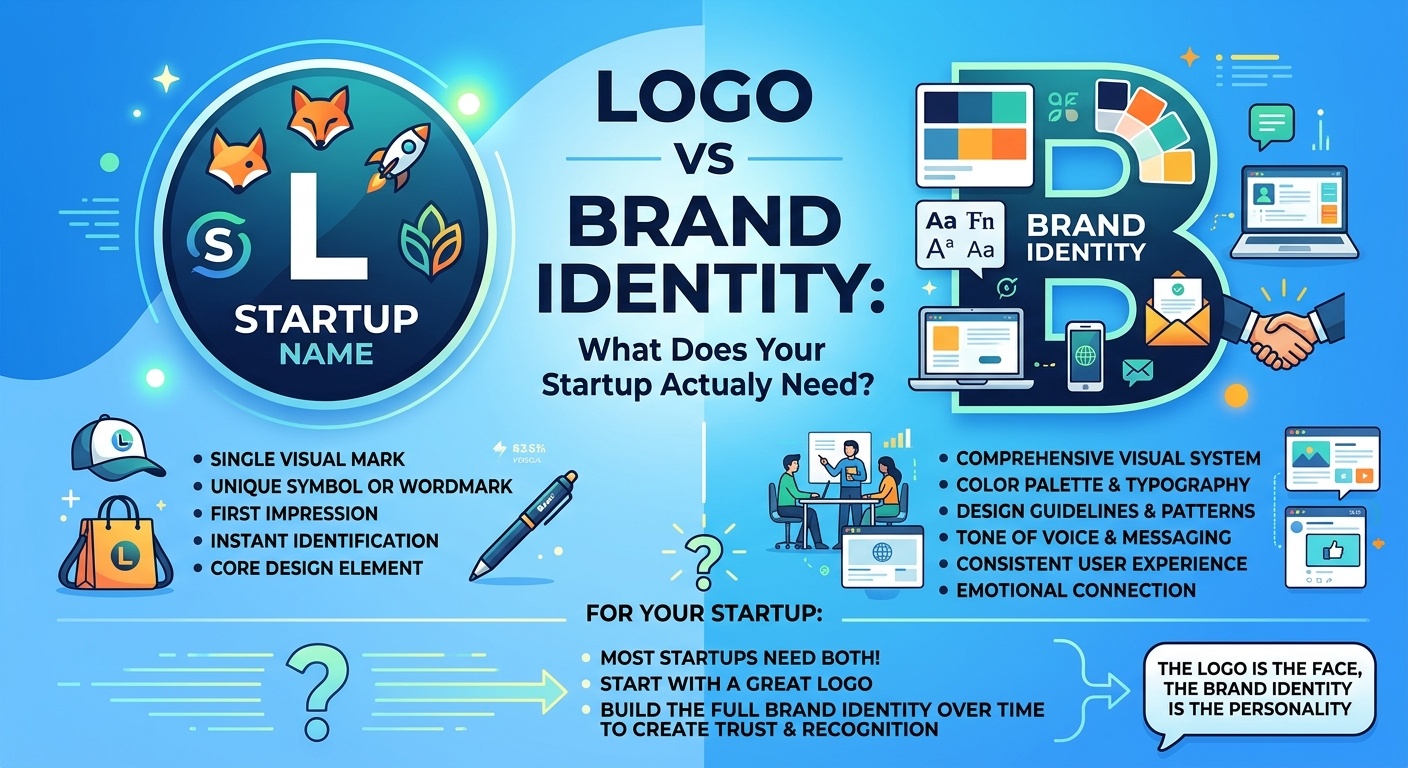
A logo is an essential part of your brand, but it is only one piece of the bigger picture. Think of your business as a house: your logo is the front door, while your brand identity is the entire house, including its colours, interior design, atmosphere, and personality.
So, should you invest in a logo first or build a complete brand identity? Let’s explore the differences, examples, costs, and best options for startups at different stages.
What Is a Logo?
A logo is a visual symbol, wordmark, or combination of both that helps people recognise your business. It gives your company a distinctive visual mark that customers can associate with your products or services.
A professional logo typically includes:
-
Symbol or icon: A graphic representing your business.
-
Typography: The style of letters used in your business name.
-
Colour palette: The colours that help make your logo recognisable.
-
Logo variations: Different versions for websites, social media, packaging, and print.
For example, a technology startup might use a simple geometric symbol and a modern wordmark to communicate innovation. A handmade skincare business might choose softer typography and a natural-looking symbol to suggest care and quality.
A logo should be memorable, readable, versatile, and appropriate for your target audience.
However, a logo alone cannot communicate every aspect of your company’s personality, values, messaging, and customer experience.
What Is Brand Identity?
Brand identity is the complete system of visual and verbal elements that communicates who your business is and what makes it different.
While a logo helps people recognise your company, a brand identity helps them understand what your company represents.
A complete brand identity may include:
-
Logo system: Primary logo, secondary logo, icons, and variations.
-
Colour palette: Primary and secondary colours for consistent communication.
-
Typography: Fonts and text hierarchy for headings, body copy, and digital interfaces.
-
Brand voice: The tone and language used in website copy, emails, and social media.
-
Imagery and graphics: Photography, illustrations, icons, and supporting visual elements.
-
Brand guidelines: Rules that explain how to use your brand consistently.
-
Digital applications: Website design, social media templates, presentations, and other customer touchpoints.
For a startup, these elements create a unified experience across its website, marketing campaigns, sales materials, and product.
A strong brand identity makes it easier for customers to recognise your business and understand why they should choose it over competitors.
Logo vs Brand Identity: The House-and-Paint Analogy
Imagine building a house.
The front door is one of the first things visitors notice. It might have a distinctive colour, design, and handle that make it easy to recognise. Your logo works in a similar way: it gives people a recognisable visual entry point to your business.
But a front door does not define the entire house.
The architecture, paint colours, furniture, lighting, layout, and atmosphere all work together to create the experience of living there. That is what a brand identity does for your business.
Your logo is the front door. Your brand identity is the whole house.
You can have a beautiful front door, but if the rest of the house looks unfinished or inconsistent, visitors may struggle to understand its character. Similarly, a startup can have an attractive logo but still look unprofessional if its website, messaging, marketing materials, and social media all feel different.
The takeaway: A logo creates recognition, while brand identity creates a consistent and meaningful impression.
Logo vs Branding: Are They the Same Thing?
The terms logo, brand identity, and branding are often used interchangeably, but they describe different things.
Branding is the broader process of shaping how people perceive your business. It includes your positioning, messaging, customer experience, reputation, and the decisions that influence how customers feel about your company.
Brand identity is the system of visual and verbal elements your business uses to express that brand.
A logo is one component of that system.
For example, a startup might use branding to position itself as an affordable, customer-friendly software provider. Its brand identity could express this through approachable typography, a bright colour palette, friendly messaging, and a simple logo. Its branding strategy would also influence pricing, customer support, marketing, and the overall product experience.
Understanding logo vs branding helps founders avoid treating a logo as the complete solution to every brand-related challenge.
Brand Identity vs Logo: Key Differences
| Feature | Logo | Brand Identity |
|---|---|---|
| Main purpose | Makes your business recognisable | Creates a consistent brand experience |
| Scope | One visual asset or logo system | A coordinated system of visual and verbal elements |
| Typical deliverables | Logo files and variations | Logo, colours, typography, voice, imagery, guidelines |
| Website impact | Provides a recognisable mark | Influences the overall look, feel, and messaging |
| Marketing use | Identifies your business | Keeps campaigns and materials consistent |
| Best for | Founders needing a basic starting point | Startups building a recognisable, scalable brand |
| Long-term value | Establishes initial recognition | Supports consistency and differentiation across touchpoints |
The most important distinction in brand identity vs logo is scope. A logo is a specific design asset; brand identity is the wider system that makes all your brand communications work together.
Logo vs Brand Identity Examples
Consider three hypothetical startups to see how the difference works in practice.
Example 1: A New Coffee Shop
A founder opening a small coffee shop might start with a distinctive wordmark and a simple coffee-inspired icon.
That logo can appear on the shop sign, takeaway cups, and social media profile. But if the menu, packaging, signage, and Instagram posts use unrelated colours and fonts, the overall experience may feel inconsistent.
A complete brand identity could introduce warm colours, consistent typography, packaging designs, photography direction, and a friendly brand voice.
The logo identifies the coffee shop. The identity helps create a recognisable atmosphere around it.
Example 2: A SaaS Startup
A software company might initially need a simple logo for its landing page and product interface.
As the business grows, it may need a more complete identity covering website layouts, product UI, typography, illustrations, pitch decks, email templates, and brand messaging.
A consistent system helps the startup present itself professionally to customers, partners, and investors.
Example 3: An Ecommerce Brand
An online clothing brand needs more than a logo on its website. Product photography, packaging, colour choices, social media campaigns, and product descriptions all influence how customers perceive the business.
A coherent identity helps the brand create a consistent experience from the first advertisement to the moment a customer opens their delivery.
These logo vs brand identity examples demonstrate that a logo can be enough for an initial launch, but a wider identity becomes increasingly valuable as a business adds products, channels, and customers.
What Does Your Startup Actually Need?
The right choice depends on your startup’s stage, available budget, and immediate business goals.
| Startup stage | Suggested budget | Recommended investment | Why |
|---|---|---|---|
| Idea or validation stage | Under £300 | Basic professional logo | Establish a recognisable starting point while testing demand |
| Early launch | £300–£800 | Logo plus essential brand elements | Create a more consistent website and marketing presence |
| Growing startup | £800–£2,500 | Core brand identity | Standardise visuals and messaging across customer touchpoints |
| Scaling business | £2,500+ | Comprehensive identity and guidelines | Support multiple campaigns, products, teams, and channels |
These are illustrative planning ranges, not fixed market prices. Actual costs vary by agency, project complexity, deliverables, and location.
Stage 1: You’re Testing a Business Idea
If you are validating demand, talking to potential customers, or building a minimum viable product, a simple professional logo may be sufficient.
Prioritise a design that is readable, adaptable, and suitable for your website and social media. Avoid spending your entire budget on branding before you know whether customers want your product.
Stage 2: You’re Preparing to Launch
If your website is going live and you are starting marketing campaigns, consider a logo with a basic identity system.
This might include a primary colour palette, typography, logo variations, and a few social media or website design guidelines.
These essentials help your startup look consistent without requiring an extensive branding project.
Stage 3: You’re Acquiring Customers
Once you are investing in advertising, content marketing, sales presentations, or ecommerce, a more complete brand identity can help your communications feel connected.
At this stage, consider adding brand messaging, imagery direction, digital design elements, and practical guidelines for future marketing materials.
Stage 4: You’re Scaling Your Business
If your startup is expanding into new markets, hiring a marketing team, launching multiple products, or working with external agencies, a comprehensive identity system becomes more useful.
Documented brand guidelines help different people create consistent materials without repeatedly making design decisions from scratch.
How Much Should a Startup Spend on a Logo or Brand Identity?
There is no universal price because the scope of work can vary significantly.
A logo-only project may cover a primary design and essential file formats. A broader identity project can involve research, positioning, multiple design concepts, typography, colour systems, brand applications, and guidelines.
When comparing proposals, check exactly what is included rather than comparing prices alone.
Ask these questions before hiring a designer:
-
How many initial concepts and revision rounds are included?
-
Will I receive editable or vector files?
-
Are light, dark, horizontal, and icon-only logo variations included?
-
Does the package include colours, typography, and brand guidelines?
-
Are website, social media, packaging, or presentation designs included?
-
What usage rights and ownership terms apply?
For startups, a staged approach can be a practical option: invest in a strong logo and essential identity elements first, then expand the system as the business grows.
Common Mistakes Startups Should Avoid
1. Treating a Logo as the Entire Brand
A logo cannot replace a clear value proposition, strong messaging, a useful product, or a good customer experience.
2. Choosing Design Without Understanding the Audience
A visually attractive logo may still be inappropriate for your market. Your design choices should reflect your audience, industry, positioning, and business goals.
3. Using Different Styles Everywhere
Unrelated fonts, colours, and imagery can make your marketing feel disconnected. Even a small identity guide can help maintain consistency.
4. Spending Too Much Too Early
A startup does not always need a comprehensive identity on day one. Invest according to your current needs and expected growth.
5. Ignoring Future Applications
Your logo should work across relevant formats, including websites, mobile screens, social media, and print. Think about how the identity can evolve as your company grows.
How to Choose the Right Option for Your Startup
Before making a decision, ask yourself three questions:
1. What stage is my business at?
If you are still testing your idea, begin with the essentials. If you are launching or scaling, consider a broader identity.
2. Where will customers interact with my brand?
A business using only a simple landing page has different requirements from an ecommerce store or SaaS company with multiple customer touchpoints.
3. Will my current design support my next stage of growth?
Choose a solution that meets your immediate needs without creating unnecessary redesign costs later.
If you are unsure, speak to a professional designer about a phased approach that prioritises the assets your business needs now.
Build a Brand That Grows With Your Startup
Understanding the difference between a logo and brand identity helps you make better design decisions and invest your startup budget more strategically.
A logo is a valuable first step because it gives people a way to recognise your business. A brand identity builds on that foundation by creating a consistent visual and verbal experience across your website, marketing, and customer communications.
You do not necessarily need a complete identity on day one. But as your business grows, a well-designed identity system can help you communicate more clearly, present your business consistently, and stand apart from competitors.
At Brands Design, we help businesses develop professional logos and cohesive brand identities that align with their goals and growth stage.
Whether you need a logo to launch your startup or a complete identity system to support your next phase of growth, the right starting point is a design strategy built around your business.
Ready to build your startup’s brand? Explore our professional logo design and branding services and discuss the right solution for your business.
Frequently Asked Questions
-
What is the difference between a logo and brand identity?
A logo is a visual mark that identifies a business. Brand identity is the wider system of elements, including the logo, colours, typography, imagery, and brand voice, that communicates the business's personality and creates consistency.
-
Can a startup succeed with just a logo?
Prices vary because designers offer different levels of research, creative development, customisation, revisions and support. A template-based logo and a strategically developed identity are different services, even if both deliver a logo file.
-
Is brand identity more important than a logo?
They serve different purposes. A logo helps people recognise your business, while brand identity helps communicate what your business represents. A strong identity includes a well-designed logo as one of its components.
-
How much does startup brand identity design cost?
Costs depend on the designer, location, scope, and deliverables. A logo-only package generally costs less than a comprehensive identity project that includes guidelines, messaging, and brand applications. Always review the proposed deliverables before comparing quotes.
-
Should I hire a logo designer or a branding agency?
A logo designer may be suitable if you need a specific visual asset. A branding agency can be a better fit if you need broader strategic direction, consistent messaging, a complete identity system, and support across multiple customer touchpoints.
-
Can I upgrade my logo into a complete brand identity later?
Yes. Starting with a logo and adding colours, typography, messaging, visual assets, and guidelines later is a practical approach for many startups. Choosing an adaptable logo from the beginning can make that process easier.
Ready to discuss your project? Contact Brands Design for a logo design quotation.
Get started with
Brands Design today
Ready to start your branding project? Get in touch
with our team to talk through what your business needs.